
 Services
Step 1
Melting and casting
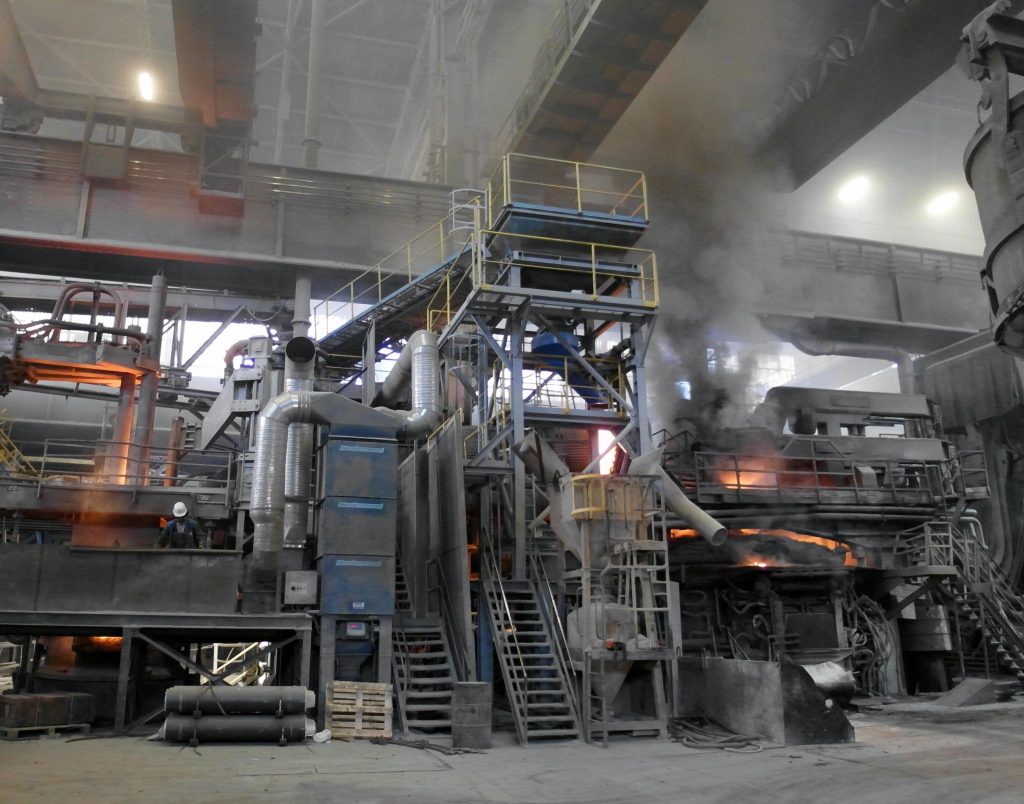
Billet production begins with the sorting of steel scrap according to defined quality classes. The charge is loaded into baskets and melted in an electric arc furnace (EAF), where alloying elements are added to achieve the required melt composition.
After melting, the steel is transferred to a ladle and treated in a ladle furnace, where secondary metallurgy processes are carried out, including alloying, temperature adjustment, and melt refining. Once the required chemical composition and temperature are achieved, the steel is cast using a continuous casting process.
The molten steel flows through a tundish into a water-cooled copper mould, where it solidifies into billets. If required, billets are charged hot into a diffusion furnace to enable controlled cooling and reduce hydrogen content. The billets are then marked and prepared for transfer to the rolling mill.
Step 2
Hot rolling
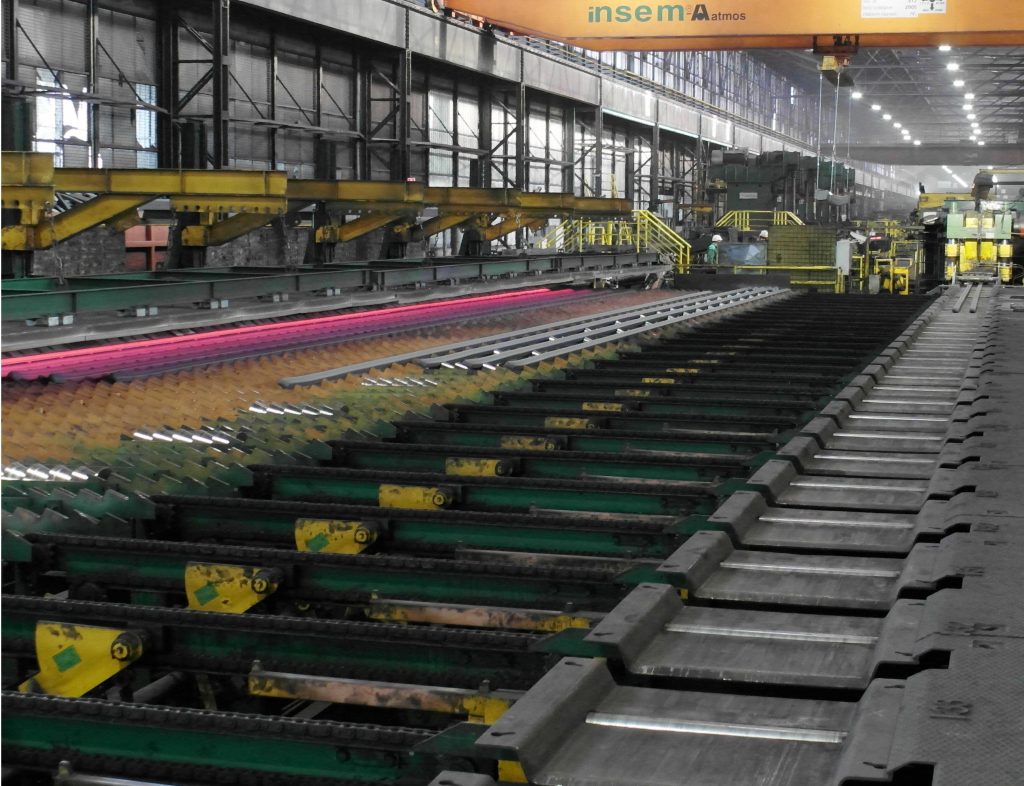
Billets (180 × 180 mm) are reheated in a walking beam furnace with a capacity of 45 t/h. Rolling is performed on two production lines, depending on the product range.
The 800 line consists of a reversible duo stand and is used for larger profiles:
- flat bars: 100–120 mm thickness, 140 mm width
- round bars: 90–140 mm diameter
- square bars: 145 mm
The continuous line with the 650 mill includes two reversible duo stands and up to nine in-line stands, producing:
- flat bars: 45–205 mm width, 6–65 mm thickness
- round bars: 20–85 mm diameter
- square bars: 40 × 40 to 70 × 70 mm
- special profiles

Step 3
Heat treatment and straightening
After rolling, the material is cooled on a cooling bed, cut to length using hot shears, and, where required, subjected to controlled cooling in chambers depending on steel grade and processing route.
Heat treatment is carried out in annealing furnaces (Ebner, Metalna, and chamber furnaces), including:
- annealing
- stress relief annealing
- normalizing
- other grade-specific heat treatment processes
Straightening is performed on Mair, Bronx, and RS-20 straightening machines, as well as hydraulic presses, ensuring dimensional accuracy and compliance with specified tolerances.

Step 4
Cold processing
In the cold finishing facility, the primary activity is the production of bright steel bars (peeled bars and related profiles).
The processing route includes:
- peeling of steel bars
- straightening and polishing
- surface inspection
- cutting to length
- CNC machining of bars
Step 5
Final inspection
Final inspection ensures that all products meet specified requirements prior to delivery. It includes dimensional verification, surface quality control, and material identification using a combination of automated and manual methods.
Dimensional, shape, and surface inspection:
- visual inspection
- shrinkage pattern evaluation
- magnetic testing (Feroflux, Circoflux)
- eddy current testing
Material identification and sorting:
- spark testing
- spectrotest
- magnatest